The New Standard in Compliance is Continuous, Not Annual

There’s a quiet upgrade happening across the assessment market: platforms that reuse evidence across frameworks so teams stop submitting the same files twice. It’s a real improvement. It’s also a smaller question than the one most security leaders are actually facing.
If you run SOC 2 and ISO 27001 side by side, a lot of the underlying work overlaps. The same policies, configuration records, and access logs that satisfy one framework satisfy similar requirements in another. Submitting that evidence separately for each engagement is wasted motion, and tooling that maps a file once and carries it across every applicable request is a good thing. We’re glad the industry is converging on it.
But efficiency inside the audit answers a question worth re-examining: why is compliance still organized around the audit at all?
The hours saved by reusing evidence are real. They’re also bounded by the model that makes those hours necessary in the first place — the one where a team prepares, gets assessed, receives a report, and then goes quiet until the next cycle. Trimming the prep work shortens each lap. It doesn’t take you off the track.
The thing a faster cycle can’t fix
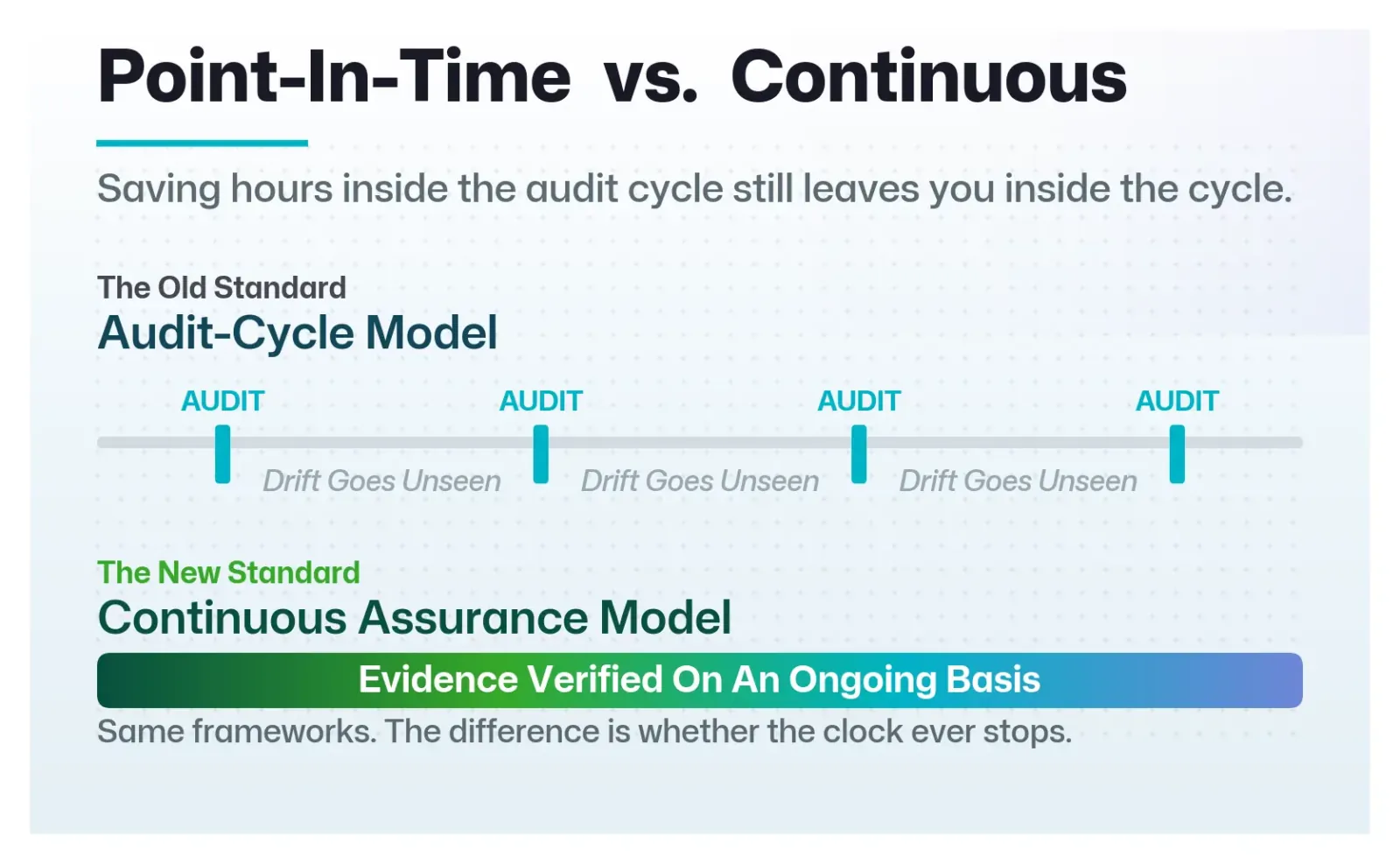
A point-in-time assessment certifies that your controls held on the days the assessor looked. The rest of the year, your posture is an assumption. Configurations drift. Access creeps. A control that passed in March quietly breaks in July, and nobody knows until the next assessment surfaces it — usually mid-fieldwork, when it’s most expensive to fix.
This is the gap no amount of evidence-matching closes, because it isn’t a duplication problem. It’s a timing problem. Faster, smarter audits still leave the long stretches between them dark. And the regulators have already moved — continuous monitoring is embedded in current FedRAMP and CMMC guidance. The annual model is the one operating behind the standard.
What “continuous” actually changes
Fortreum was built around a different default: compliance as an ongoing state of assurance rather than a recurring event. Continuous monitoring keeps evidence synchronized with the live system, so drift is caught when it happens, not at the next assessment. The question shifts from “are we ready for the audit” to “are we compliant right now” — with the answer available on demand, and the audit-prep scramble retired as a recurring disruption.
That shift only holds up if the people behind it can stand on both sides of the line. Fortreum is an accredited assessment body — a Top 5 FedRAMP 3PAO by authorization volume, an accredited GovRAMP 3PAO, an ISO certification body, and an authorized C3PAO for CMMC. We also operate the continuous assurance platform underneath. Most of the market does one or the other. Doing both is what connects the rigor of a formal assessment to the visibility of always-on monitoring, rather than handing you a report and walking away.
The technology layer matters here. Fortreum is powered by KOVR, an AI-native compliance platform built on retrieval-augmented generation: every output is grounded in evidence retrieved from the customer’s own environment, with a sub-0.5% hallucination rate on critical controls. The point isn’t AI for its own sake — it’s the engine that makes ongoing, multi-framework verification practical at scale, with credentialed human authority validating the output. As our team puts it, a confident wrong answer in a federal package isn’t time-saving; it’s a liability.
The honest version of the multi-framework story
Evidence does carry across frameworks, and we’ll say so plainly: where control requirements genuinely overlap, the work should happen once. Any serious platform should do that. The caveat is the assumption that overlap is the whole game. Frameworks share evidence at the parameter level, but they don’t share intent — SOC 2 doesn’t get you to FedRAMP, and FedRAMP and CMMC aren’t interchangeable. Each requires credentialed personnel specific to that authorization. Treating “we passed one” as “we’re most of the way to the next” is how organizations talk themselves into surprises during a federal assessment.
So by all means, reuse the evidence. Consolidate the meetings. Cut the duplicated prep. Then ask the bigger question underneath it: when the audit is over, who’s watching?
Saving hours inside the cycle is good. Getting out of the cycle is the new standard.
If your compliance program still goes quiet between assessments, there’s a better default. Fortreum can map your frameworks to a continuous model — assessed with authority and monitored year-round. Talk to the team at fortreum.com.